Lost Hudson Aircraft found after 82 years
An Australian warplane disappeared 82 years ago.
Now, it's been found.
By PNG correspondent Marian Faa
Topic: World War II
Sun 14 Dec Sunday 2025
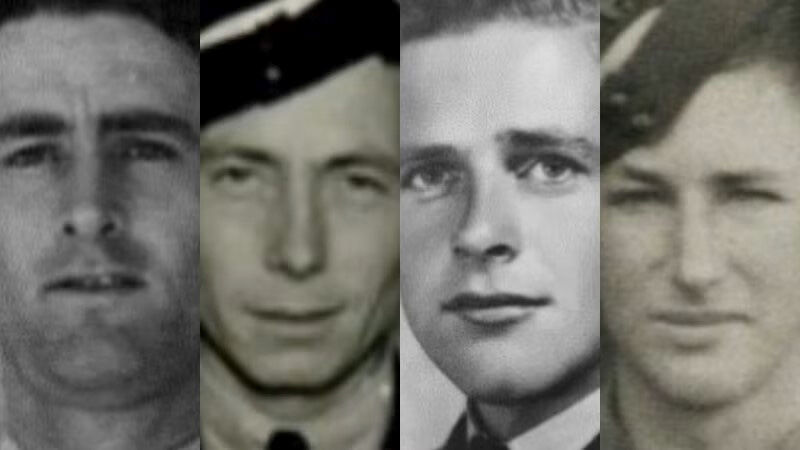
Four young men were on board the Beaufort A9-211 when it crashed on December 14, 1943.
When Robert Burrowes got a phone call asking if he was related to Australian Air Force (RAAF) crew member Thomas Burrowes, he had no idea an 82-year-old mystery had just been solved.
He assumed the genealogist from the Australian Defence Force was just ringing to do some research.
"I thought, 'Well they're just being thorough,'" he tells the ABC in an exclusive interview from his home in Melbourne.
"She hadn't given any hint at all."
After more than eight decades, Mr Burrowes had just about given up hope of ever knowing what truly happened to his uncle Tom, who disappeared in World War II.
Tom was just sixteen when he joined the RAAF cadets but couldn't become a pilot because he'd had rheumatic fever as a child.
When the Pacific War broke out, Tom was called up to fight as a wireless air gunner in Papua New Guinea.
About 10pm on December 14, 1943, Tom took off on his first bombing mission in a Beaufort Bomber A9-211, one of nine Squadron 100 planes involved in an air attack.
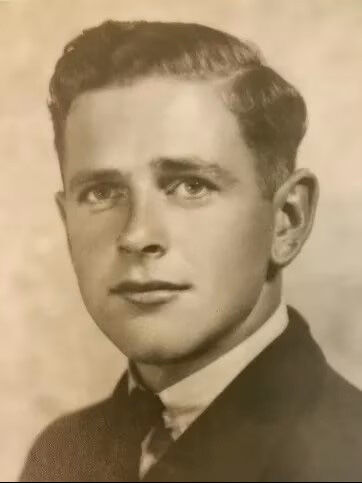
Tom Burrowes was serving as an
RAAF gunner when he went missing.
(Supplied: James Burrowes)
"The mission was to fly over and bomb Rabaul, which at that point was a well-held Japanese base," Robert Burrowes says.
But the weather was terrible that night and the mission did not go to plan.
"Only three [planes] made the target … two bombed alternate targets, four returned to base without even completing the mission," Mr Burrowes says.
"Tragically, one plane did not return to base."
That was the aircraft Tom was on, alongside Flight Sergeants John Kenny, Arthur John Davies, and Murray Fairbairn.
Mystery of the missing plane
The aircraft was never located, and from that night, the whereabouts of Tom and his crew remained a mystery.
WWII crew identified in PNG waters
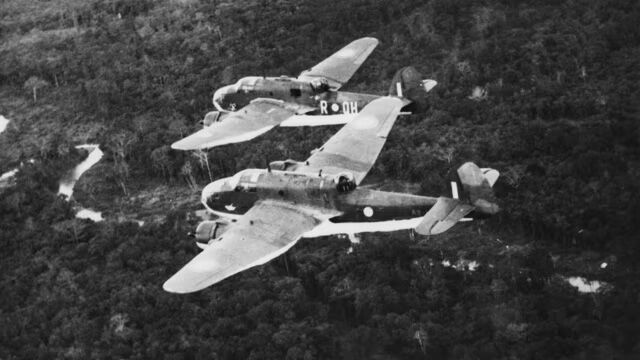
The recovered Beaufort bomber was similar to these aircraft,
pictured flying over jungle country in New Guinea in 1943.
(Supplied: Australian War Memorial)
Almost eight decades after their aircraft crashed in waters south of Papua New Guinea, Australian crew members have been identified.
It was particularly painful for Robert's father, Jim Burrowes, who was Tom's twin brother.
Jim also served in Rabaul during World War II as a Coastwatcher, whose role was to gather intelligence and alert the Australian military of possible threats.
Their older brother, Bob, died as a captured soldier on the Japanese prisoner-of-war ship Montevideo Maru, which sank in 1942 and was finally discovered in 2023.
But when Jim passed away last year, aged 101, Tom's whereabouts was still unknown.
"He was resigned to the fact he'd probably never find out," Robert Burrowes says.
'I started bawling immediately.'
"Well, as it turned out, if he lived one more year, he would've."
In October, about a week after chatting with the ADF genealogist, Robert Burrowes received another call — this time from Group Captain Grant Kelly.
A propeller from Beaufort A9-211 erected on the site by local villagers as a memorial to the crew. (Supplied: Australian Defence Force)
The voice at the end of the line explained that he had led a special RAAF unit focused on locating missing war casualties.
This time, the penny dropped.
"He was halfway through the third sentence, and I thought 'Bloody hell, they've found the plane'. I started bawling immediately," Mr Burrowes says.
Group Captain Kelly recounted how he and a small team had led an expedition into the remote mountains of Rabaul, in Papua New Guinea, after teenager Willie Flinn discovered the wreck while trekking through the bush in 2022.
It wasn't an easy mission; it took years of planning and a couple of false starts.
"PNG is a complex place. And with the considerations of that remote site, it took us 'til October this year before we could complete that investigation," Group Captain Kelly says.
But even once they reached the plane, success was far from certain.
"We don't know what evidence is there, whether it's complete," he says.
"It's 80 years old. It's been subject to damage, disturbance, deterioration. The tropical jungle is not a friendly site or not friendly to wreckage … this was extremely torn apart."
But in less than an hour of being on site, they had a breakthrough.
"We were very lucky that within half an hour … we were able to discover a component plate, a modification plate that identified the aircraft as A9-211," Group Captain Kelly says.
For him, it's a discovery that helps families, veterans, and the Air Force piece together the past.
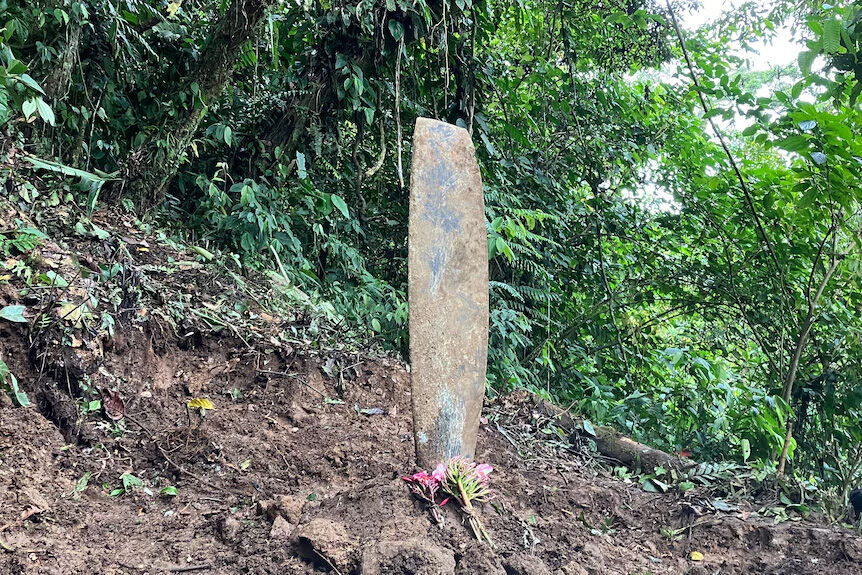
A propeller from Beaufort A9-211 erected on the site by local villagers as a memorial to the crew.
(Supplied: Australian Defence Force)
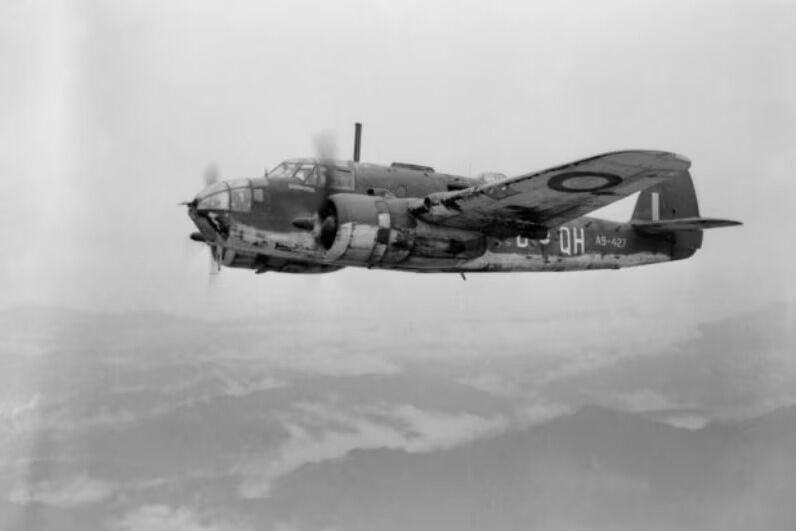
This Beaufort bomber is the same design as those flying the mission of 14-15 December 1943.
(Supplied: Australian War Memorial)
"Every missing plane is a story that is not complete. And when we're able to identify these planes, it completes the story," he says.
Stirring emotions
For Robert Burrowes, discovering his uncle Tom's final resting place has stirred up a complex blend of feelings.
"They call it closure. I'm not sure that that's quite the right word," he says.
Sitting in a living room surrounded by pictures of his relatives, he gently wipes a tear from his eyes.
"I feel very emotional. Yeah, it's pretty upsetting, but it's also good to know."
Some of the details of the plane crash have been difficult to process.
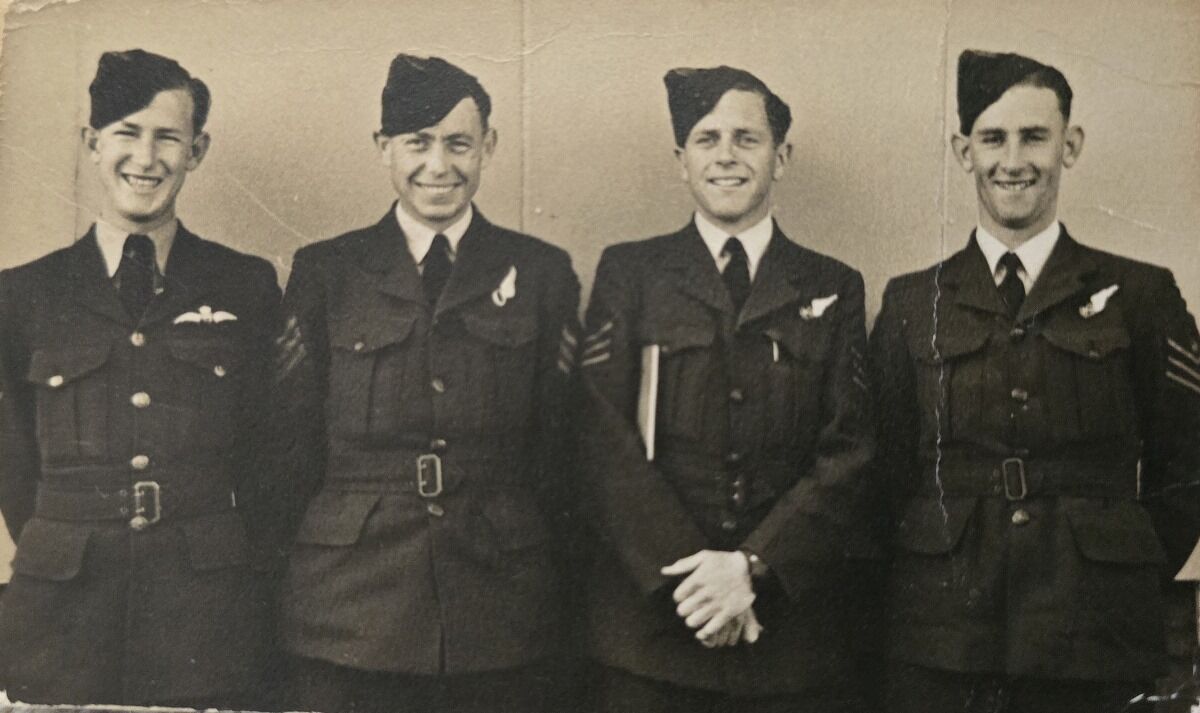
Flight sergeants John Kenny, Arthur Davies, Thomas Burrowes, and Murray Fairbairn of No. 100 Squadron Beaufort A9-211.
(Supplied: Australian Defence Force)
"It was in a nosedive, basically, and it burned on impact," he says.
"It's not fun to imagine what it would have been like in those last terrifying moments as the plane is in a nosedive and presumably completely out of control."
Mr Burrowes also feels a deep sadness that his father Jim didn't live to find out where his twin brother came to rest.
"He only missed it by a year," he says.
"It would have meant everything to him. It was the only remaining unanswered question of his life."
Bone fragments being tested.
For Danielle Baker, the granddaughter of navigator Arthur Davies, who also died in the crash, the discovery has helped answer questions she has been asking her whole life.
"It's always been in the back of my head," she says.
"Did he get shot down? Did he get picked up by the enemy? Did he ever suffer?
"But now we've sort of got this peace of mind that they hit the mountain because the weather was so tragically horrible. And probably it was very quick."
A small amount of bone fragment, which could be human remains, has been found at the site and will undergo forensic testing.
Ms Baker thinks it could belong to her grandfather.
"There had been some burnt remains found at the front of the plane," she says.
"With my grandfather being the navigator, he was probably up the front end of the plane … technically, I'd probably think that's grandad."
If that is proven, she knows exactly what she will do.
"It'd be great if we could get a bit of that home so I could bury him or put him next to his wife and his daughter," Ms Baker says.
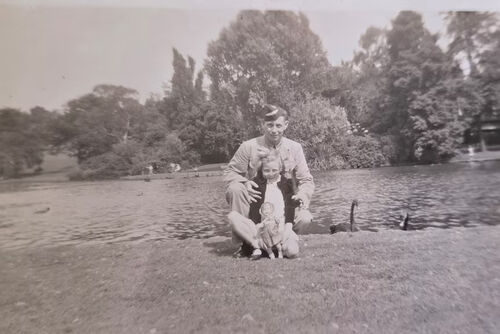
RAAF pilot Arthur Davies with his daughter Judith.
(Supplied: Danielle Baker)
LINKS:
ABC News 14/12/25
Murray Fairbairn
Virtual War Memorial Australia - Murray Fairbairn